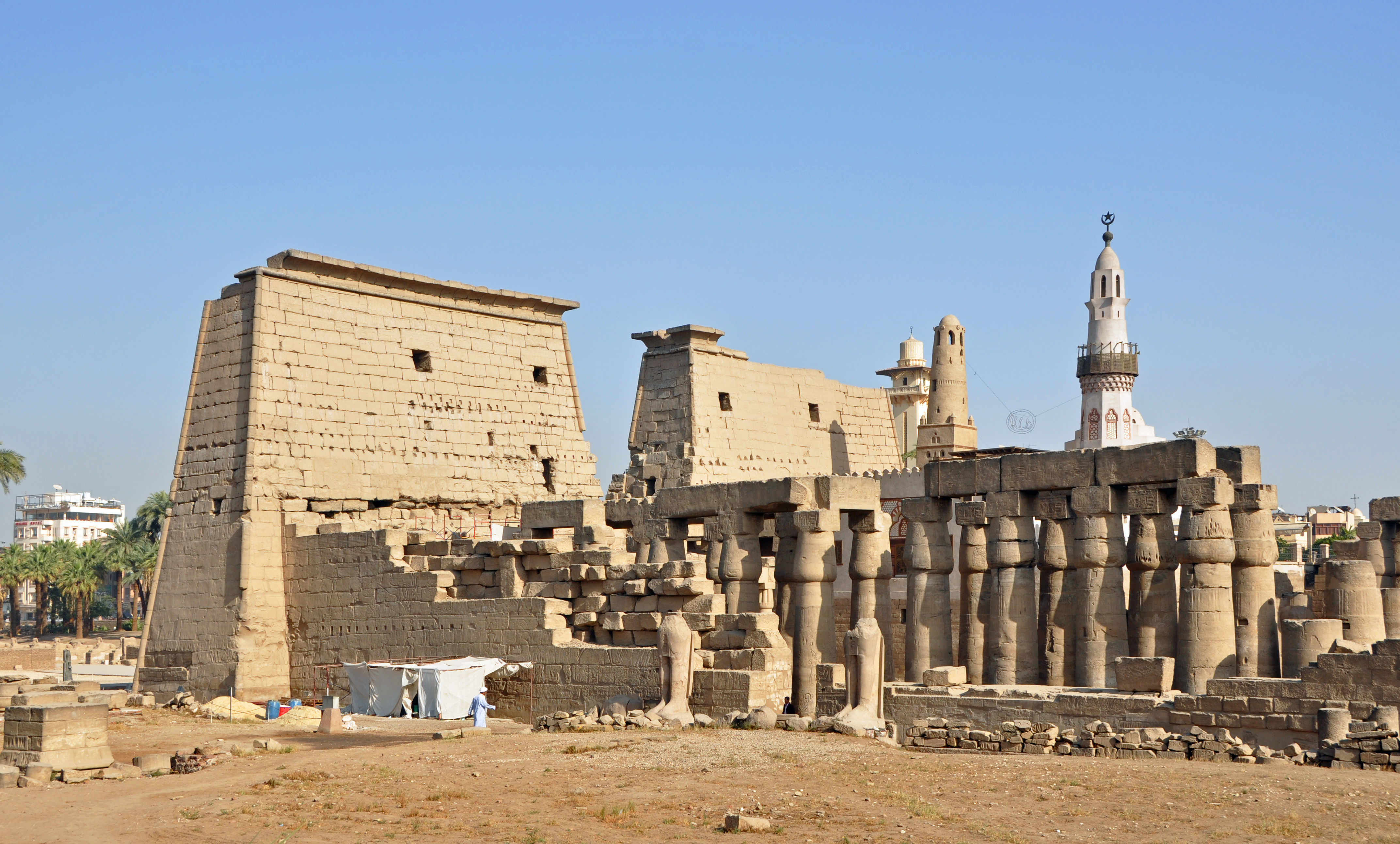
Photo: Marc Ryckaert (MJJR) · CC BY 3.0
Luxor
Ancient Thebes — temples on one bank of the Nile, royal tombs on the other.
About
Luxor holds the greatest concentration of ancient monuments anywhere in the world. On the east bank stand the temple complexes of Karnak and Luxor; on the west, the Valley of the Kings, where sixty-odd rock-cut tombs include Tutankhamun's, alongside the terraced mortuary temple of Hatshepsut. Balloons go up over the west bank at dawn, and feluccas work the river between them.
Highlights
- Karnak temple complex
- Valley of the Kings
- Hatshepsut's temple
- Dawn balloon flights
What to see in Luxor
Museums, monuments and historic sites, described from Wikipedia where there is an article.
 Historic siteValley of the KingsThe Valley of the Kings, also known as the Valley of the Gates of the Kings, is an area in Egypt where, for a period of nearly 500 years from the Eighteenth Dynasty to the Twentieth Dynasty, rock-cut tombs were excavated for pharaohs and powerful nobles under the New Kingdom of ancient Egypt. It is a wadi sitting on the west bank of the Nile, opposite Thebes (modern-day Luxor) and within the heart of the Theban Necropolis. There are two main sections: the East Valley, where the majority of the royal tombs are situated; and the West Valley, otherwise known as the Valley of the Monkeys.Photo: Fotograf/Photographer: Peter J. Bubenik (1995) · CC BY-SA 2.0
 Historic siteKarnak Temple ComplexThe Karnak Temple Complex, commonly known as Karnak (), comprises a vast mix of temples, pylons, chapels, and other buildings near Luxor, Egypt. Construction at the complex began during the reign of Senusret I (reigned 1971–1926 BC) in the Middle Kingdom (c. 2000–1700 BC) and continued into the Ptolemaic Kingdom (305–30 BC), although most of the extant buildings date from the New Kingdom. The area around Karnak was the ancient Egyptian Ipet-isut ("The Most Selected of Places") and the main place of worship of the 18th Dynastic Theban Triad, with the god Amun as its head.Photo: Vyacheslav Argenberg · CC BY 4.0
 Historic siteLuxor TempleThe Luxor Temple (Arabic: معبد الأقصر) is a large Ancient Egyptian temple complex located on the east bank of the Nile River in the city of Luxor (ancient Thebes) and was constructed around 1400 BC. In Egyptian it was known as ipet resyt, "the southern sanctuary". It was one of the two primary temples on the east bank, the other being Karnak. Unlike the other temples in Thebes, Luxor temple is not dedicated to a cult god or a deified version of the pharaoh in death.Photo: Ad Meskens · CC BY-SA 3.0
 Historic siteValley of the QueensThe Valley of the Queens is a site in Egypt, in which queens, princes, princesses, and other high-ranking officials were buried from roughly 1560 BC to 1130 BC. Pharaohs were buried in the Valley of the Kings. The Valley of the Queens was known anciently as Ta-Set-Neferu, which has a double meaning of "The Place of Beauty" and/or "the Place of the Royal Children". Excavation of the tombs at the Valley of the Queens was pioneered by Ernesto Schiaparelli and Francesco Ballerini in the early 1900s.Photo: Diego Delso · CC BY-SA 4.0
 Historic siteDeir el-BahariDeir el-Bahari or Dayr al-Bahri (Arabic: الدير البحري, romanized: al-Dayr al-Baḥrī, lit. 'the Northern [lit., "Seaward"] Monastery', Coptic: ⲡⲧⲟⲡⲟⲥ ⲛⲁⲡⲁ ⲫⲟⲓⲃⲁⲙⲙⲱⲛ, lit. 'the monastery of Apa Phoibammon', Ancient Egyptian: djeser-djeseru) is a complex of mortuary temples and tombs located on the west bank of the Nile, opposite the city of Luxor, Egypt. This is a part of the Theban Necropolis.Photo: Diego Delso · CC BY-SA 4.0
 Historic siteKV62 Tomb of TutankhamenThe tomb of Tutankhamun (reigned c. 1332–1323 BC), a pharaoh of the Eighteenth Dynasty of ancient Egypt, is located in the Valley of the Kings. The tomb, also known by its tomb number KV62, consists of four chambers and an entrance staircase and corridor. It is smaller and less extensively decorated than other Egyptian royal tombs of its time, and it probably originated as a tomb for a non-royal individual that was adapted for Tutankhamun's use after his premature death.Photo: EditorfromMars · CC BY-SA 4.0
 Historic siteColossi of MemnonThe Colossi of Memnon (Arabic: el-Colossat or es-Salamat) are two large stone statues of the Pharaoh Amenhotep III, which stand at the front of the ruined Mortuary Temple of Amenhotep III, the largest temple in the Theban Necropolis. They have stood since 1350 BC, and were well known to ancient Greeks and Romans, as well as early modern travelers and Egyptologists. The statues contain 107 Roman-era inscriptions in Greek and Latin, dated to between AD 20 and 250; many of these inscriptions on the northernmost statue make reference to the Greek mythological king Memnon, whom the statue was then erroneously thought to represent.Photo: MusikAnimal · CC BY-SA 4.0
 Historic siteTheban NecropolisThe Theban Necropolis (Arabic: مدينة طيبة الجنائزية, romanized: Madīnat Ṭaybah al-Janāʼizīyah) is a necropolis on the west bank of the Nile, opposite Thebes (Luxor) in Upper Egypt. It was used for ritual burials for much of the Pharaonic period, especially during the New Kingdom.Photo: Steve F-E-Cameron · CC BY 3.0
 Historic siteRamesseumThe Ramesseum is the memorial temple (or mortuary temple) of Pharaoh Ramesses II ("Ramesses the Great"). It is located in the Theban Necropolis in Upper Egypt, on the west of the River Nile, across from the modern city of Luxor. It is the second largest temple in Egypt, occupying an area of c. 10 hectares (1,100,000 sq ft). It was originally called the House of millions of years of Usermaatra-setepenra that unites with Thebes-the-city in the domain of Amun. Usermaatra-setepenra was the prenomen of Ramesses II.Photo: Diego Delso · CC BY-SA 4.0
 Historic siteDayr al-MadīnahDeir el-Medina (Egyptian Arabic: دير المدينة), or Dayr al-Madīnah, is an ancient Egyptian workmen's village which was home to the artisans who worked on the tombs in the Valley of the Kings during the 18th to 20th Dynasties of the New Kingdom of Egypt (ca. 1550–1080 BC). The settlement's ancient name was Set maat ("Place of Truth"), and the workmen who lived there were called "Servants in the Place of Truth". During the Christian era, the temple of Hathor was converted into a Monastery of Saint Isidorus the Martyr (Coptic: ⲡⲧⲟⲡⲟⲥ ⲙ̄ⲫⲁⲅⲓⲟⲥ ⲁⲡⲁ ⲓⲥⲓⲇⲱⲣⲟⲥ ⲡⲙⲁⲣⲧⲉⲣⲟⲥ) from which the Egyptian Arabic name Deir el-Medina ("Monastery of the City") is derived.Photo: Diego Delso · CC BY-SA 4.0
 Historic siteKV1 Rameses VIITomb KV1, located in the Valley of the Kings in Egypt, was used for the burial of Pharaoh Ramesses VII of the Twentieth Dynasty. Although it has been open since antiquity, it was only properly investigated and cleared by Edwin Brock in 1984 and 1985. The single corridor tomb is located in Luxor's West Bank, and is small in comparison to other tombs of the Twentieth Dynasty.Photo: Chabe01 · CC BY-SA 4.0
 Historic siteMortuary Temple of HatshepsutThe mortuary temple of Hatshepsut (Egyptian: Ḏsr-ḏsrw, lit. 'Holy of Holies') was built during the reign of Pharaoh Hatshepsut of the Eighteenth Dynasty of Egypt. Located opposite the city of Luxor, it is considered to be a masterpiece of ancient architecture. Its three massive terraces rise above the desert floor and into the cliffs of Deir el-Bahari. Hatshepsut's tomb, KV20, lies inside the same massif capped by El Qurn, a pyramid for her mortuary complex. At the edge of the desert, 1 km (0.62 mi) east, connected to the complex by a causeway, lies the accompanying valley temple.Photo: Ian Lloyd · CC BY-SA 3.0
- Historic siteKV8 MerenptahTomb KV8, located in the Valley of the Kings, was used for the burial of Pharaoh Merenptah of Ancient Egypt's Nineteenth Dynasty. The burial chamber, located at the end of 160 metres of corridor, originally held a set of four nested sarcophagi. The outer one of these was so voluminous that parts of the corridor had to have their doorjambs demolished and rebuilt to allow it to be brought in. These jambs were then rebuilt with the help of inscribed sandstone blocks which were then fixed into place with dovetail cramps. The pillars in Chamber F were removed to allow passage of the sarcophagus, only two were replaced.
 Historic siteKV7Tomb KV7 was the tomb of Ramesses II ("Ramesses the Great"), an ancient Egyptian pharaoh during the Nineteenth Dynasty. It is located in the Valley of the Kings opposite the tomb of his sons, KV5, and near to the tomb of his son and successor Merenptah, KV8.Photo: Piotr Matyja · CC BY-SA 3.0
 Historic siteKV5 Sons of Rameses IITomb KV5 is a subterranean, rock-cut tomb in the Valley of the Kings. It belonged to the sons of Ramesses II. Though KV5 was partially excavated as early as 1825, its true extent was discovered in 1995 by Kent R. Weeks and his exploration team. The tomb is now known to be the largest in the Valley of the Kings. Weeks' discovery is widely considered the most dramatic in the valley since the discovery of the tomb of Tutankhamun in 1922.Photo: R.F.Morgan · CC BY-SA 3.0
 Historic siteKV2 Ramses IVTomb KV2, found in the Valley of the Kings, is the tomb of Ramesses IV, and is located low in the main valley, between KV7 and KV1. It has been open since antiquity and contains a large amount of graffiti.Photo: Gary Todd from Xinzheng, China · CC0
- Historic siteKV3 Son of Rameses IIITomb KV3, located in Egypt's Valley of the Kings, was intended for the burial of an unidentified son of Pharaoh Ramesses III during the early part of the Twentieth Dynasty. It is similar in design to the "straight axis" tombs typical of this dynasty, and an ostracon written in hieratic script from the time of Ramesses III mentions the founding of a tomb for a royal prince, likely this tomb. The unfinished state of a couple of rooms in the tomb along with scant archeological evidence suggests that the tomb was never used.
 Historic siteKV9 Rameses V and Rameses VITomb KV9 in Egypt's Valley of the Kings was originally constructed by Pharaoh Ramesses V. He was interred here, but his uncle, Ramesses VI, later reused the tomb as his own. The architectural layout is typical of the 20th Dynasty – the Ramesside period – and is much simpler than that of Ramesses III's tomb (KV11). The workmen accidentally broke into KV12 as they dug one of the corridors. The works on KV9 are responsible for the preservation of the tomb of Tutankhamun, the entrance of which was buried beneath huts built for the craftsmen working on Ramesses VI's tomb. In 2020, the Egyptian Tourism Authority released a full 3D model of the tomb with detailed photography, available online.Photo: Diego Delso · CC BY-SA 4.0
 Historic siteKV11 Ramses IIITomb KV11 is the tomb of Pharaoh Ramesses III. It is located in the main valley of the Valley of the Kings. The tomb was originally started by Setnakhte, but abandoned when it unintentionally broke into the earlier tomb of Amenmesse (KV10). Setnakhte was buried in KV14. The tomb KV11 was later restarted and extended and on a different axis for Ramesses III. The tomb has been open since antiquity, and has been known variously as "Bruce's Tomb" (named after James Bruce who entered the tomb in 1768) and the "Harper's Tomb" (due to paintings of two blind harpers in the tomb).Photo: R Prazeres · CC BY-SA 4.0
 Historic siteKV17 Sety IThe tomb of Seti I, also known by its tomb number, KV17, is the tomb of Pharaoh Seti I of the Nineteenth Dynasty. Located in Egypt's Valley of the Kings, It is also known by the names "Belzoni's tomb", "the Tomb of Apis", and "the Tomb of Psammis, son of Nechois". It is one of the most decorated tombs in the valley, and is one of the largest and deepest tombs in the Valley of the Kings. It was uncovered by Italian archaeologist and explorer Giovanni Belzoni on 16 October 1817.Photo: Jean-Pierre Dalbéra · CC BY 2.0
 Historic siteKV16 Ramses ITomb KV16 is located in the Valley of the Kings in Egypt. It was used for the burial of Pharaoh Ramesses I of the Nineteenth Dynasty. The burial place was discovered by Giovanni Belzoni in October 1817. As Ramesses I ruled for less than two years, his sepulchre is rather truncated, being only twenty-nine metres long. It consists of two descending staircases, linking a sloping corridor and leading to the burial chamber. Like the tomb of Horemheb (KV57), the grave is decorated with the Book of Gates. The sarcophagus, still in place in the final chamber, is constructed of red quartzite.Photo: Diego Delso · CC BY-SA 4.0
 Historic siteKV35 Amenhetep IIThe tomb of Amenhotep II, also known by its tomb number, KV35, is the burial place of Amenhotep II, a pharaoh of the Eighteenth Dynasty of Egypt, in the Valley of the Kings in Luxor, Egypt. Later, it was used as a cache for other royal mummies. It was discovered by Victor Loret in March 1898.Photo: Ignati · CC BY-SA 3.0
 Historic siteKV4 Rameses XIKV4 is a tomb in the Valley of the Kings (Egypt). The tomb was initiated for the burial of Ramesses XI but it is likely that its construction was abandoned and it was not used for Ramesses's interment. It also seems likely that Pinedjem I intended to usurp this tomb for his own burial, but that he too abandoned the plan. KV4 is notable for being the last royal tomb that was quarried in the Valley and because it has been interpreted as being a workshop used during the official dismantling of the royal necropolis in the early Third Intermediate Period.Photo: R.F.Morgan · CC BY-SA 3.0
- Historic siteTomb of Tuthmosis IIITomb KV34 (Arabic: مقبرة تحتمس الثالث, romanized: Maqbarat Tahtamis al-Thaalithi) in the Valley of the Kings (near the modern-day Egyptian city of Luxor) was the tomb of 18th Dynasty Pharaoh Thutmose III. The tomb was plundered in antiquity and its location lost. It was rediscovered and first excavated in 1898 under Victor Loret.
Things to book in Luxor
No experiences listed yet
Where to stay in Luxor
Green Oasis Villa
Listed for reference — book direct
Mama Africa Camp
Listed for reference — book direct
Mr. Hostel
Listed for reference — book direct

Rezeiky Hotel Luxor
Listed for reference — book direct

Sofitel Winter Palace Luxor
Listed for reference — book direct

Sonesta St. George Hotel
Listed for reference — book direct

Steigenberger Nile Palace
Listed for reference — book direct

Steigenberger Resort Achti
Listed for reference — book direct
The Bob Marley House Sherief Hotel
Listed for reference — book direct
Partner inventory
Check live prices for Luxor
Hotels sold through our booking partner, with real availability for your dates. Separate from the Zuri operators and directory listings above.