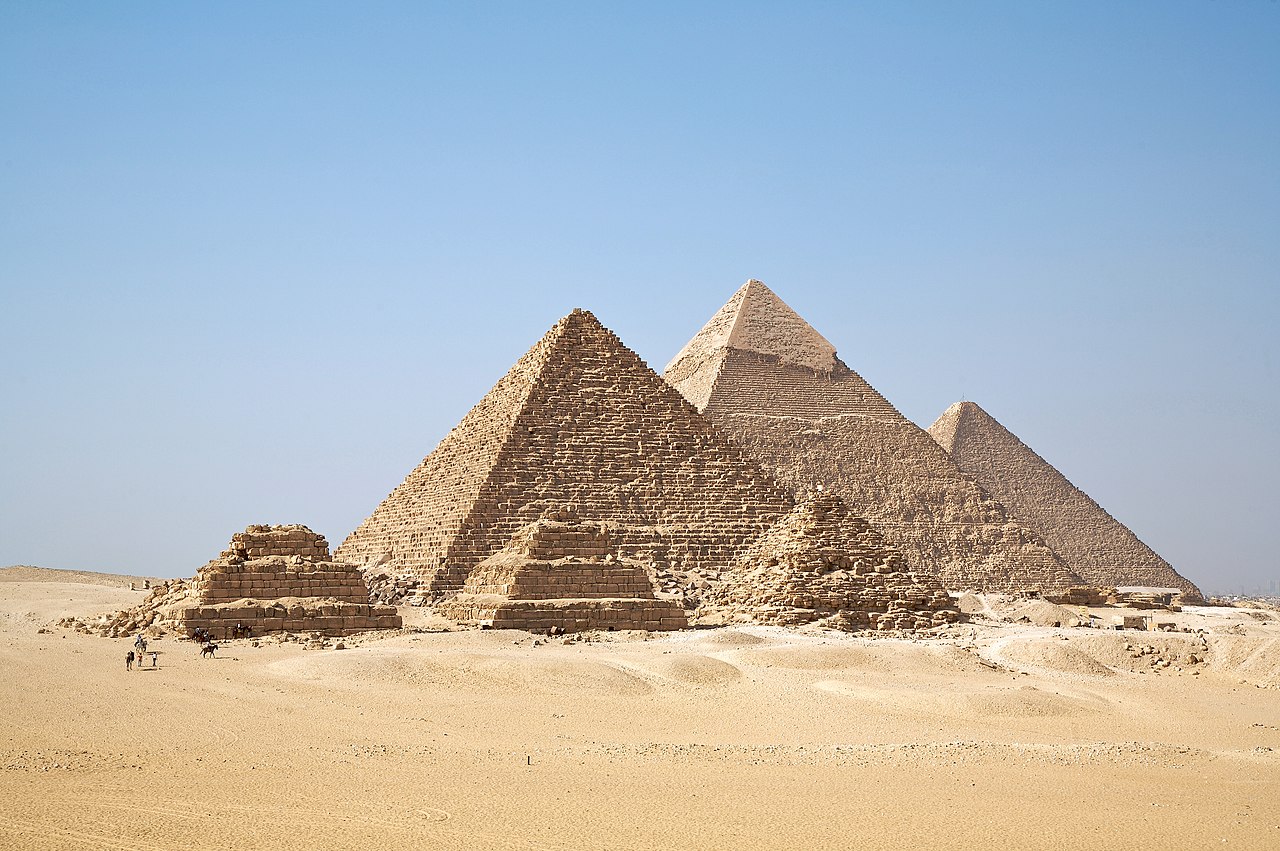
Photo: Ricardo Liberato · CC BY-SA 2.0
The Pyramids of Giza
The last of the seven ancient wonders still standing, at the edge of a city of twenty million.
About
The Great Pyramid was built for Khufu around 2560 BC and stood as the tallest structure on earth for nearly four thousand years. Three pyramids, the Sphinx and a field of smaller tombs sit on a desert plateau that the suburbs of Giza now reach right up to — the contrast is part of the experience. The Grand Egyptian Museum, alongside the plateau, holds the complete Tutankhamun collection.
Highlights
- Great Pyramid of Khufu
- The Sphinx
- Grand Egyptian Museum
- Saqqara and Dahshur nearby
What to see in The Pyramids of Giza
Museums, monuments and historic sites, described from Wikipedia where there is an article.
 Historic siteGreat Pyramid of GizaThe Great Pyramid of Giza is the largest of the Egyptian pyramids and the most famous landmark of the Giza pyramid complex in Giza, Egypt. It is the oldest of the Seven Wonders of the Ancient World, and the only wonder that has remained largely intact. The Great Pyramid served as the tomb of Egyptian Pharaoh Khufu ("Cheops"), who ruled during the Fourth Dynasty of the Old Kingdom. It was built c. 2600 BC over a period of about 26 years. Initially standing at 146.6 metres (481 feet), the Great Pyramid was the world's tallest human-made structure for more than 3,700 years.Photo: Nina · CC BY 2.5
 Historic siteGiza PyramidsThe Giza pyramid complex (also called the Giza necropolis) in Egypt is home to the Great Pyramid, the pyramid of Khafre, and the pyramid of Menkaure, along with their associated pyramid complexes and the Great Sphinx. All were built during the Fourth Dynasty of the Old Kingdom of ancient Egypt, between c. 2600 – c. 2500 BC. The site also includes several temples, cemeteries, and the remains of a workers' village. The site is at the edge of the Western Desert, approximately 9 km (5.6 mi) west of the Nile River in the city of Giza, and about 13 km (8.1 mi) southwest of the city centre of Cairo.Photo: KennyOMG · CC BY-SA 4.0
 MonumentThe Great SphinxThe Great Sphinx of Giza is a limestone statue of a resting sphinx, a mythical creature with the head of a human and the body of a lion. The monument was sculpted from the limestone bedrock of the Eocene-aged Mokattam Formation and faces east on the Giza Plateau, on the west bank of the Nile in Giza, Egypt. The oldest known monumental sculpture in Egypt, the Sphinx is part of the Memphite Necropolis and is a UNESCO World Heritage Site. Archaeological evidence suggests the Sphinx was created by Egyptians of the Old Kingdom during the reign of Khufu (c. 2590–2566 BC) or Khafre (c. 2558–2532 BC).Photo: MusikAnimal · CC BY-SA 3.0
 MuseumEgyptian MuseumThe Museum of Egyptian Antiquities, commonly known as the Egyptian Museum (Egyptian Arabic: المتحف المصرى, romanized: al-Matḥaf al-Miṣrī, Egyptian Arabic pronunciation: [elˈmætħæf elˈmɑsˤɾi]) and also called the Cairo Museum or the Egyptian Museum in Cairo (EMC), is a national history museum in Cairo, Egypt. An Egyptological museum, it houses the largest collection of Egyptian antiquities in the world, including over 170,000 items. The Egyptian Museum occupies a building constructed in 1901 on Tahrir Square and is one of the largest museums in Africa as well as the first national museum of the Middle East.Photo: Holger Uwe Schmitt · CC BY-SA 4.0
- Historic siteTombs of 3rd DynastyThe Third Dynasty of ancient Egypt (Dynasty III) is the first dynasty of the Old Kingdom. Other dynasties of the Old Kingdom include the Fourth, Fifth and Sixth. The capital during the period of the Old Kingdom was at Memphis.
 Historic siteDjoser Pyramid complex in SakkaraThe Pyramid of Djoser, sometimes called the Step Pyramid of Djoser or Step Pyramid of Horus Netjerikhet, is an archaeological site in the Saqqara necropolis, Egypt, northwest of the ruins of Memphis. It was the first Egyptian pyramid to be built. The six-tier, four-sided structure is the earliest colossal stone building in Egypt. It was built in the 27th century BC during the Third Dynasty for the burial of Pharaoh Djoser. The pyramid is the central feature of a vast mortuary complex in an enormous courtyard surrounded by ceremonial structures and decoration. The pyramid went through several revisions and redevelopments of the original plan.Photo: Olaf Tausch · CC BY 3.0
 Historic sitePyramid of KhafreThe pyramid of Khafre or of Chephren is the middle of the three Ancient Egyptian Pyramids of Giza, the second tallest and second largest of the group. It is the only pyramid out of the three that still has cladding at the top. It is the tomb of the Fourth-Dynasty Pharaoh Khafre (Chefren), who ruled c. 2558−2532 BC.Photo: Most likely Hamish2k, the first uploader · CC BY-SA 3.0
 Historic sitePyramid of MenkaureThe pyramid of Menkaure is the smallest of the three main pyramids of the Giza pyramid complex, located on the Giza Plateau in the southwestern outskirts of Cairo, Egypt. It is thought to have been built to serve as the tomb of the Fourth Dynasty King Menkaure. With roughly one tenth of the volume of the pyramid of Khufu, it is a part of a Egyptian pyramid complex comprising a mortuary temple and a valley temple linked by a causeway, together with three subsidiary pyramids on its southern side. Numerous signs of unfinished work indicate that the king died while the monument was still under construction, leaving its completion to his successor Shepseskaf.Photo: kallerna · CC BY-SA 3.0
 MuseumGrand Egyptian MuseumThe Grand Egyptian Museum (GEM; Egyptian Arabic: المتحف المصري الكبير el-Matḥaf el-Maṣriyy el-Kebir) is a national archaeological museum in Giza, Egypt. Dedicated to Ancient Egypt and its culture, society, and artifacts, the GEM is the largest museum in the world for a single civilization. Located about 2 kilometres (1.2 mi) from the Giza Pyramid complex, the museum houses a collection of Egyptian artifacts from various periods of Egyptian civilization, from the Predynastic Period to Roman Egypt.Photo: Amr F.Nagy · Public domain
 LandmarkEl Azhar MosqueAl-Azhar Mosque (Arabic: الجامع الأزهر, romanized: al-Jāmiʿ al-ʾAzhar, lit. 'The Resplendent Congregational Mosque'), known in Egypt simply as al-Azhar, is a mosque in the historic Islamic core of the city of Cairo, Egypt. Commissioned as the new capital of the Fatimid Caliphate in 970 CE, it was the first mosque established in a city that eventually earned the nickname "the City of a Thousand Minarets". Its name is usually thought to derive from az-Zahrāʾ (lit. 'the shining one'), a title given to Fatima, the daughter of Muhammad. After its dedication in 972, and with the hiring by mosque authorities of 35 scholars in 989, the mosque slowly developed into what it is today.Photo: Daniel Mayer · CC BY-SA 4.0
 Historic siteSalah El Din CitadelThe Citadel of Cairo or Citadel of Saladin (Arabic: قلعة صلاح الدين, romanized: Qalaʿat Salāḥ ad-Dīn) is a medieval Islamic-era fortification in Cairo, Egypt. Its construction was begun by Salah ad-Din (Saladin) in 1176 and continued by subsequent Egyptian rulers. It was the seat of government in Egypt and the residence of its rulers for nearly 700 years from the 13th century until the construction of Abdeen Palace in the 19th century. Its location on a promontory of the Mokattam hills near the center of Cairo commands a strategic position overlooking the city and dominating its skyline.Photo: Ahmed Al.Badawy from Cairo, Egypt · CC BY-SA 2.0
 Historic sitePyramid of UnasThe pyramid of Unas (Egyptian: Nfr swt Wnjs, lit. 'Beautiful are the places of Unas') is the funerary monument built for the Egyptian pharaoh Unas, the ninth and final king of the Fifth Dynasty, in the 24th century BC. It is the smallest Old Kingdom pyramid, but significant due to the discovery of Pyramid Texts – spells for the king's afterlife – incised into the walls of its subterranean chambers. Inscribed for the first time in Unas's pyramid, the tradition of these funerary texts carried on in the pyramids of subsequent rulers through to the end of the Old Kingdom, and into the Middle Kingdom through the Coffin Texts that form the basis of the Book of the Dead.Photo: User:Roweromaniak · CC BY-SA 2.5 pl
 Historic sitePyramid of NeferirkareThe pyramid of Neferirkare (Egyptian: Bꜣ Nfr-ỉr-kꜣ-rꜥ, lit. 'The ba of Neferirkare') is the funerary monument built for the Egyptian pharaoh Neferirkare Kakai of the Fifth Dynasty in the 25th century BC. It is the tallest, highest-situated structure in the Abusir necropolis – located between Giza and Saqqara – over which it still towers. The Fifth Dynasty marked the end of the great pyramid constructions that had prevailed during the Fourth Dynasty. Pyramids of the era were smaller and the complexes followed a standardized template, though this coincided with the proliferation of intricate relief decoration. Neferirkare's main pyramid deviated from contemporary convention.Photo: No machine-readable author provided. Neithsabes assumed (based on copyright claims). · Public domain
 Historic sitePyramid of SahureThe pyramid of Sahure (Egyptian: Ḫꜥỉ-bꜣ Sꜣḥw-Rꜥ, lit. 'Rising of the ba of Sahure') is the funerary monument built for the Egyptian pharaoh Sahure of the Fifth Dynasty in the late 26th to 25th century BC. This initiated a period of pyramid building by Sahure's successors in Abusir, on a location earlier used by Userkaf for his sun temple. The site was first properly excavated by Ludwig Borchardt between March 1907 and 1908, who wrote the standard work Das Grabdenkmal des Königs Sahu-Re ('The Funerary Monument of King Sahure') between 1910 and 1913.Photo: No machine-readable author provided. Neithsabes assumed (based on copyright claims). · Public domain
 Historic siteLayer PyramidThe Layer Pyramid (known locally in Arabic as el haram el midawwar, Arabic: الهرم المدور, meaning 'rubble-hill pyramid') is a ruined step pyramid dating to the 3rd Dynasty of Egypt (2686 BC to 2613 BC) and located in the necropolis of Zawyet El Aryan. Its ownership is uncertain and may be attributable to pharaoh Khaba. The pyramid architecture, however, is very similar to that of the Buried Pyramid of king Sekhemkhet and for this reason is firmly datable to the 3rd Dynasty. The pyramid was excavated at the beginning of the 20th century by two different teams who reported conflicting estimates regarding its size and number of subterranean chambers.Photo: Pottery Fan · CC BY-SA 3.0
 LandmarkCairo TowerThe Cairo Tower (Arabic: برج القاهرة, Borg El-Qāhira) is a free-standing concrete tower in Cairo, Egypt. At 187 m (614 ft), it was the tallest structure in Egypt for 37 years until 1998, when it was surpassed by the Suez Canal overhead powerline crossing. It was the tallest structure in North Africa for 21 years until 1982, when it was surpassed by the Nador transmitter in Morocco. It was the tallest structure in Africa for one year until 1962, when it was surpassed by Sentech Tower in South Africa.Photo: Mohamedusrii · CC BY 4.0
 Historic sitePyramid of UserkafThe pyramid complex of Userkaf was built for the pharaoh Userkaf, founder of the 5th Dynasty of Egypt (c. 2494–2345 BC). It is located in the pyramid field at Saqqara, on the north-east of the step pyramid of Djoser. Constructed in dressed stone with a core of rubble, the pyramid is now ruined and resembles a conical hill in the sands of Saqqara. For this reason, it is known locally as El-Haram el-Maharbish, the "Heap of Stone", and was recognized as a royal pyramid by western archaeologists in the 19th century.Photo: No machine-readable author provided. Neithsabes assumed (based on copyright claims). · Public domain
 Historic siteBuried PyramidThe Step Pyramid of Sekhemkhet (Buried Pyramid) is an unfinished seven-step pyramid constructed c. 2645 BC for Sekhemkhet. He was the second king of the Third Dynasty of Ancient Egypt, which reigned over Egypt c. 2686–2613 BC and is usually placed at the beginning of the Old Kingdom of Egypt. Many historians believe that the third dynasty played an important role in the transition from Early Dynastic Period of Egypt to the Age of the Pyramids. The pyramid may be visited, but the public is not allowed access to the base and substructures. Sekhemkhet Djoserty was also the successor to the better-known pharaoh Netjerikhet Djoser, who was buried in his famous step pyramid at Saqqara.Photo: Pottery Fan · CC BY-SA 3.0
 LandmarkPyramid of DjedefreThe pyramid of Djedefre is Egypt's northernmost pyramid. Believed to have been built by Djedefre, son and successor to king Khufu, it consists today mostly of ruins located at Abu Rawash in Egypt. An excavation report on the pyramid complex was published in 2011.Photo: No machine-readable author provided. AhlyMan assumed (based on copyright claims). · Public domain
 LandmarkHanging ChurchSaint Virgin Mary's Coptic Orthodox Church (Coptic: ϯⲉⲕⲕⲗⲏⲥⲓⲁ̀ ⲛ̀ⲧⲉⲑⲉⲟⲇⲟⲕⲟⲥ ϯⲁ̀ⲅⲓⲁ̀ ⲙⲁⲣⲓⲁ̀ ϧⲉⲛⲃⲁⲃⲩⲗⲟⲛ ⲛ̀ⲭⲏⲙⲓ Church of Mother of God Saint Mary in Egyptian Babylon), also known as the Hanging Church (Arabic: الكنيسة المعلقة, romanized: al-Kanīsa al-Muʿallaqa, Coptic: ⲁ̀ⲛⲁⲃⲁϯ ϧⲉⲛⲡⲓⲥⲡⲉⲗⲉⲟⲛ ϧⲉⲛⲃⲁⲃⲩⲗⲱⲛ ⲛ̀ⲭⲏⲙⲓ), is one of the oldest churches in Egypt which dates to the third century. It belongs to the Coptic Orthodox Church of Alexandria.Photo: Berthold Werner · CC BY-SA 3.0
 Historic siteAbdin PalaceAbdeen District is the home of Abdeen Palace, a 19th-century Cairo palace built by Khedive Ismail and served as the Egyptian royal household's primary official residence from 1874 until the 1952 Egyptian revolution. Since then it has been one of the presidential palaces. The palace is centered in its eponymous district, administratively part of the Western Area of Cairo, and part of the Khedival Cairo Area of Value to the west of Historic Cairo.Photo: Gérard Ducher ( user:Néfermaât ) · CC BY-SA 2.5
 Historic sitePyramid of NyuserreThe pyramid of Nyuserre (Egyptian: Mn-swt Nỉ-wsr-rꜥ, lit. 'Enduring are the places of Nyuserre') is the funerary monument built for the Egyptian pharaoh Nyuserre Ini of the Fifth Dynasty in the mid-25th-century BC. During his reign, Nyuserre had the unfinished monuments of his father, Neferirkare Kakai, mother, Khentkaus II, and brother, Neferefre, completed, before commencing work on his personal pyramid complex. He chose a site in the Abusir necropolis between the complexes of Neferirkare and Sahure, which, restrictive in area and terrain, economized the costs of labour and material. Nyuserre was the last king to be entombed in the necropolis; his successors chose to be buried elsewhere.Photo: No machine-readable author provided. Neithsabes assumed (based on copyright claims). · Public domain
 MuseumNational Museum of Egyptian CivilisationThe National Museum of Egyptian Civilization (NMEC) is a large museum located in Old Cairo, a district of Cairo, Egypt. Partially opened in 2017, the museum was officially inaugurated on 3 April 2021, with the moving of 22 mummies, including 18 kings and four queens, from the Egyptian Museum in central Cairo, in an event termed the Pharaohs' Golden Parade. The museum displays a collection of 50,000 artifacts, presenting the Egyptian civilization from prehistoric times to the Modern era.Photo: Roland Unger · CC BY-SA 4.0
 Historic sitePyramid of TetiThe pyramid of Teti is a smooth-sided pyramid situated in the pyramid field at Saqqara in Egypt which belonged to Teti, founder of the sixth dynasty of Egypt. It is the second known pyramid containing Pyramid Texts. Excavations have revealed a satellite pyramid, two pyramids of queens accompanied by cult structures, and a funerary temple. The pyramid was opened by Gaston Maspero in 1882 and the complex explored during several campaigns ranging from 1907 to 1965. It was originally called Teti's Places Are Enduring. The preservation above ground is very poor, and it now resembles a small hill. Below ground the chambers and corridors are very well preserved.Photo: Wknight94 talk · CC BY-SA 3.0
Things to book in The Pyramids of Giza
No experiences listed yet
Where to stay in The Pyramids of Giza


Partner inventory
Check live prices for The Pyramids of Giza
Hotels sold through our booking partner, with real availability for your dates. Separate from the Zuri operators and directory listings above.
Where to eat and drink in The Pyramids of Giza
Also listed here
- RestaurantsAl Gnani Al Demeshqi (Dokki Chillout branch)
- RestaurantsBreadfast
- RestaurantsBuffalo Burger - Faisal
- RestaurantsBuffalo Burger - Hadayek Al Ahram
- RestaurantsBuffalo Burger - Mall of Egypt
- RestaurantsBuffalo Burger - Mohandeseen
- RestaurantsElMohamady
- RestaurantsKhufu's Restaurant
- CafésLocation Cafe
- RestaurantsRoma Pizza to Go - Hadayek Al Ahram
- RestaurantsRoma Pizza to Go - Mall of Egypt
- CafésRoom Art Space
- CafésZiznia
- Restaurantsil Nilo Garden City
- Restaurantsshikh el araab (saif)
- Restaurantsأهل اليمن
- Restaurantsالشيف صابر
- Cafésالمصطبه
- Restaurantsمطعم ابو حسين العراقي
- Restaurantsمطعم جحا
- Restaurantsمطعم زهرة الشام
